Courses
GIS Courses
DE denotes Distance Education courses (Click for more information on Distance Education)
APP denotes applications-oriented courses specifically recommended for GIS Certificate and Minor students. (GIS APP courses that are not required for the master's degree can be used as electives for the master's degree.)
CLASSROOM denotes Classes that are also taught in the classroom
Note: GIS 510 is a pre-requisite for GIS 515, GIS 520, GIS 521, GIS 530, GIS 540. GIS 540 is a pre-requisite for GIS 550 and GIS 590. Unless special permission is granted, all MGIST students must take GIS 510. GIS 510 cannot be taken concurrently with GIS 520.
- GIS 510 - Introduction to Geographic Information ScienceDE, APP, CLASSROOM
- Formerly NR 531
- Advanced applications in ESRI ArcMap
- Raster modeling with ESRI Spatial Analyst
- Introduction to spatial database structures
- Elementary customization of ESRI interface
- Extensive study of ESRI modelbuilder
- GIS 512 - Introduction to Environmental Remote SensingDE, CLASSROOM
- Formerly FOR 554
- Introduction to the Electromagnetic Spectrum
- Digital image composites and band combinations
- Image display and visualization
- Image enhancements and rectification
- Image segmentation and classification
- Digital stereoscopy and evaluation techniques
- GIS 515 – Computer Cartography DE only, APP
- Formerly NR 535
- Offered during the summer
- Basic design principles applicable to all cartographic communication.
- Effective map presentations of both general and discipline specific information.
- Design and production of maps for print publication and the internet.
- GIS 520 - Advanced Geospatial Analytics DE only, APP
- Introduction to Web Mapping Services
- Offered during the summer
- Advanced spatial modeling in ESRI ArcMap
- Intermediate customization of ESRI interface
- Introduction to spatial data mining
- Introductory spatial statistics
- GIS 521- Surface Water Hydrology with GIS DE only, APP
- Formerly NR 595 special topic
- Introduction to GIS for surface hydrology
- Terrian Derivatives
- Data sources, use, and analysis of digital elevation model, surface water, soils, and other related data
- Using Arc Hydro
- Watershed delineation and characterization
- Flood plain modeling
- Calculating credits for LEED Site Planning
- MEA/GIS 582 - Geospatial Modeling and AnalysisDE, APP, CLASSROOM
- Data acquisition, integration, display, and 3D visualization
- Neighborhood and proximity operators, map algebra
- Cost surfaces, least cost path, emergency response applications
- Spatial interpolation and approximation
- Terrain and bathymetry mapping and modeling, LIDAR data processing
- Topographic analysis, line of sight, viewshed analysis
- Flow tracing, watershed analysis, landforms
- Modeling of geospatial processes
- GIS-based hydrologic and erosion modeling (introduction)
- Solar radiation, photovoltaic energy potential assessment
- Hands-on experience with open source GRASS GIS and ArcGIS
- MEA 592/GIS 595 - Multidimensional Geospatial ModelingDE, CLASSROOM
- Analysis of landscape dynamics using multitemporal data and simulations
- Processing series of lidar point clouds and surfaces
- Concept of space-time cube representation, analysis and visualization
- Modeling landscape processes using particle sampling
- Visualization of 3D and multitemporal data
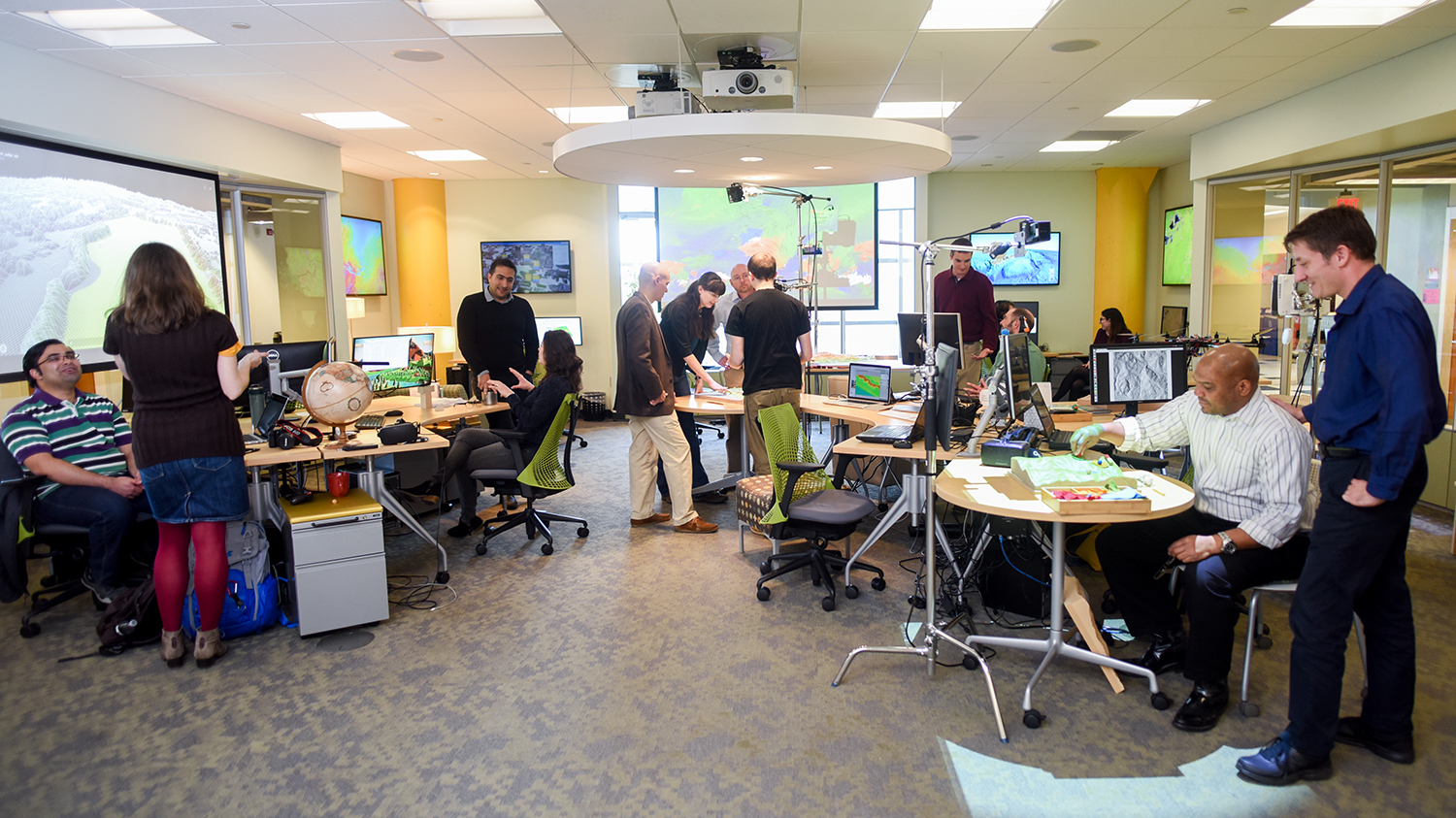
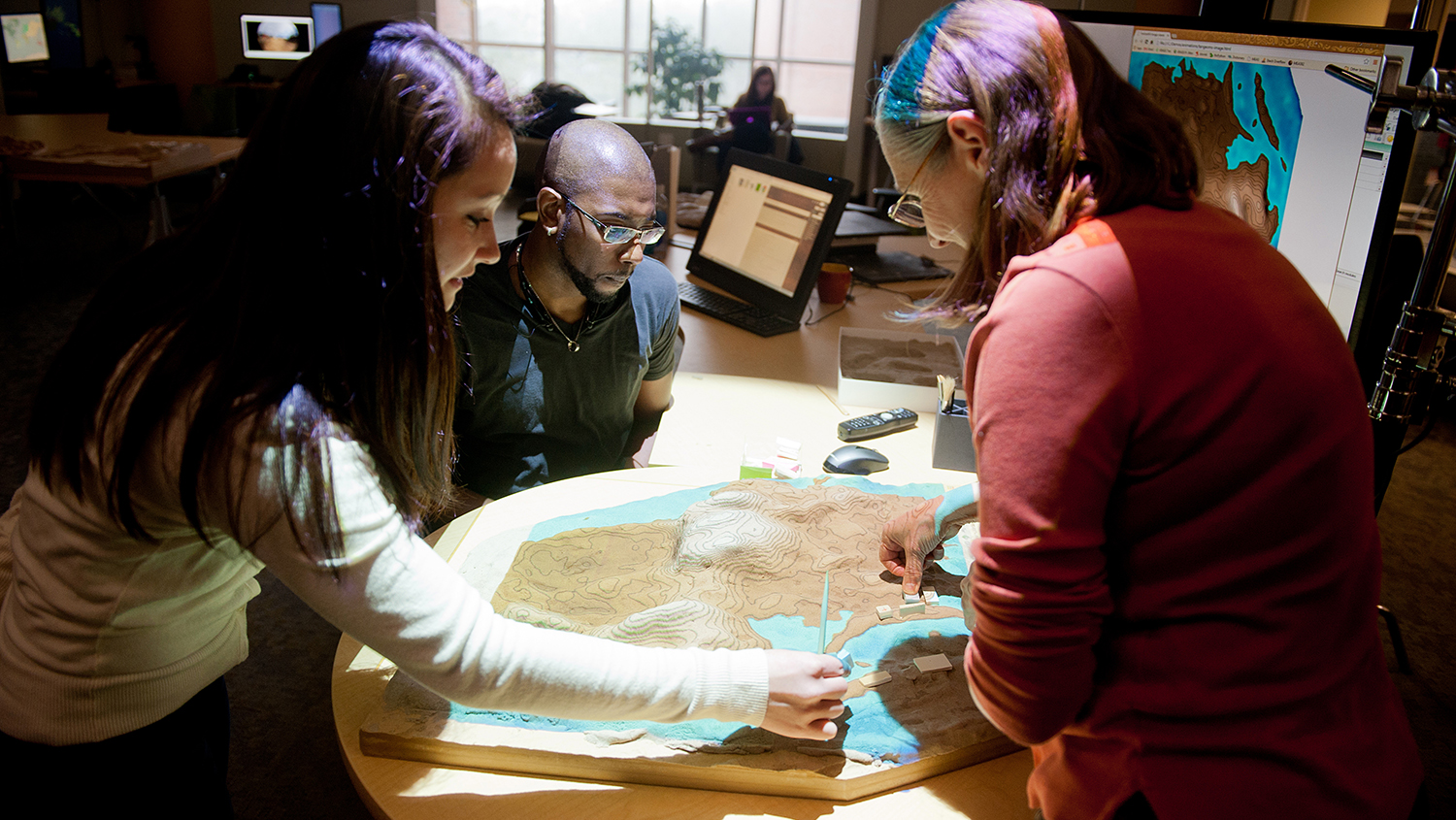
- Hands-on practice and development of techniques for visualization
of landscape dynamics using the state of the art technology in the GIST Visualization laboratory, - Open source geospatial software development infrastructure
- GIS 530 - Principles of Geographic Information ScienceDE, CLASSROOM
- Formerly NR 532
- Introduction to spatial information systems from a mathematical and information science perspective--not a software applications perspective.
- Geographic data formats (discrete, continuous, raster, vector)
- Georeferencing, map projections, scale
- Geographic data: scale, sampling, measuring distance/similarity, census data
- Generalization
- Geodatabase, topology, digitizing
- Spatial analysis: polygon overlay, query, transformation, interpolation.
- Spatial analysis: summaries, inference, raster analysis, patterns, routing
- GIS 540 - Geospatial Programming FundamentalsDE, CLASSROOM
- Formerly NR 595d special topics
- Automating data preparation, workflow, and spatial processing (via Python)
- Basic programming: Pseudocode, Python syntax, variables, strings, keywords, integrated development environments
- Exporting Modelbuilder models to scripts
- Programming components: flow control, built-in data structures, debugging, file i/o, user-defined functions and modules, built-in modules, introduction to object-oriented programming, using object classes
- Performing GIS analysis
- Batch processing
- Manipulating attribute tables
- Customizing Arc desktop with script tools and buttons
- Managing map layers, adding layers to maps with Python
- Project: Customizing Arc desktop with script tools
- GIS 550 - Geospatial Data Structures and Web Services DE, CLASSROOM
- Formerly NR 533
- Database models: Relational models, Object-oriented data modeling with universal modeling language (UML)
- Distributed database concepts and implementation, query language
- Transactions, recovery, security, ArcSDE with SQL (or Oracle) server
- Web delivery (including open source software)
- Interoperability, Open Geospatial Consortium (OGC) standards
- Web services
- GIS 590, section 603 - Geospatial Information Science Master's Project Course DE
- Formerly NR 693
- Electronic Portfolio - Each student will develop a web based portfolio demonstrating their technical and management skills in GIS&T. The portfolio will be both a resume of the students credentials and a review of program breadth and quality
-
Project description - Students will work with a community partner to design and implement a significant "real world" project addressing a complex spatial data management and analysis issue. Projects will emanate from contacts with private sector firms and government agencies and be provided to the students.
- GIS 610-651- Eportfolio Design DE
- Temporary Course Number (Special Topics)
- Design of digital portfolio
Related Courses
DE denotes Distance Education courses
Business Management
- BUS 590 Strategic Management Foundations DE
- MBA 551 Service Management and MarketingDE
- MBA 552 Management Issues in Organizational CultureDE
- MBA 553 Business Process Design and AnalysisDE
Computer Science
Communication
- COM 521 Communication and GlobalizationDE
- COM 530 Interspersonal Communication in Science and Technology Organizations DE
Engineering, Biological & Agricultural
- BAE 535 (SSC 535) Precision Agriculture TechnologyDE
- BAE 585 AutoCAD Civil 3D-GIS IntegrationDE (1 credit)
- BAE 590 GIS Apps in Precision AgricultureDE
Engineering, Civil
Engineering, Electrical
Engineering, Industrial and Systems
Forestry and Environmental Resources
- FOR 510 Introduction to GPS
- GIS 512 Introduction to Environmental Remote Sensing DE and classroom
- FOR 753 Environmental Remote Sensing
Landscape Architecture
- LAR 500 Landscape Design Studio (only 3 of the 6 credit hours can be applied toward the certificate - contact the GIS academic coordinator for more information)
Marine, Earth, & Atmospheric Sciences
- MEA 511 Introduction to Meterological Remote Sensing
- MEA 582/GIS 582 Geospatial Modeling and AnalysisDE
- MEA 592 Applied Data Analysis in the Earth Sciences using Matlab
- MEA 592 Tectonic Geomorphology
- MEA 592 Advanced Earth Surface Processes - Landscape Evolution
- MEA 792 Advanced Geospatial Modeling with Open Source GIS
Public Administration
Soil Science
- SSC/CS/BAE 440 GIS in Production AgricultureDE
- SSC/BAE 535 Precision Agriculture TechnologyDE
- SSC 545 Remote Sensing Applications in Soil Science & AgricultureDE
Statistics
ANY 500-level or above Statistics course, including:
- ST 507 Statistics for the Behavioral Sciences IDE
- ST 508 Statistics for the Behavioral Sciences IIDE
- ST 511 Experimental Statistics for Biological Sciences I DE
- ST 512 Experimental Statistics for Biological Sciences II
- ST 733 Applied Spatial Statistics
All GIS course pages can be found at wolfware.ncsu.edu
The MGIST and the Graduate Certificate programs can be completed on campus or from a distance. To view our Distance Education sections, please go the NC State's Distance Education website.